top of page
< Back

Crawler Crane Boom Strikes Talmadge Memorial Bridge in Savannah, GA

A lattice crawler crane boom struck the Talmadge Memorial Bridge in Savannah while being transported on a barge along the Savannah River. The boom went over the rear of the crane and fell onto the deck and into the water. No injuries were reported. Georgia DOT temporarily closed the bridge for inspection before reopening it several hours later. Recovery operations removed the fallen boom later the same day.
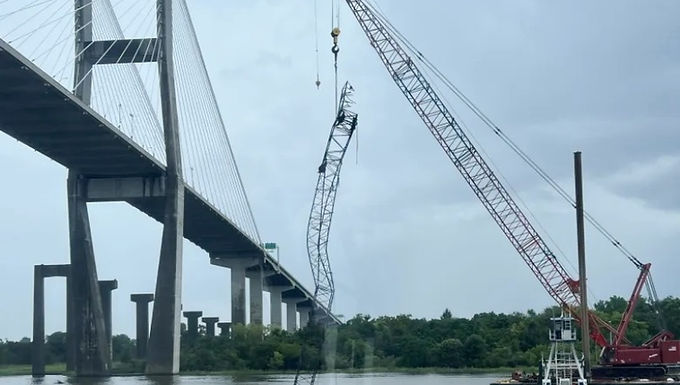
30-Second Takeaway A lattice crawler crane boom struck the underside of the Talmadge Memorial Bridge in Savannah on Friday while being transported on a barge along the Savannah River. The boom subsequently went over the rear of the crane and fell onto the barge deck and into the water. No injuries were reported. Georgia Department of Transportation temporarily closed the bridge for inspection before reopening it several hours later. Recovery operations removed the fallen boom later the same day. Incident Overview A lattice crawler crane  mounted on a barge  was involved in a bridge-strike incident on Friday   August 1st  while transiting beneath the Talmadge Memorial Bridge  in Savannah, Georgia . As the barge attempted to pass under the bridge, the crane’s boom struck the underside of the main span . Following the impact, the boom went over the rear of the crane , crashing onto the barge deck and into the river. What Is Known Location:  Savannah River, Savannah, Georgia Bridge involved:  Talmadge Memorial Bridge (US 17 / SR 404 Spur) Crane type:  Lattice crawler crane mounted on a barge Tow vessel:   Lorna Myrick , owned by Myrick Marine Injuries:  None reported The incident was captured on video  by personnel aboard another barge and crane travelling in the same direction. Official Response The Georgia Department of Transportation (GDOT)  issued a statement following the incident, confirming the temporary closure of the bridge: “The US 17/SR 404 Spur Bridge in Savannah will be closed beginning this afternoon so that the agency can conduct an inspection of the bridge, following a bridge strike incident in which a crane struck the underside of the main span of the bridge during a crane transit on the Savannah River.” GDOT stated the bridge would remain closed for an indeterminate period out of an abundance of caution  while inspections were completed. The bridge was reopened approximately four hours later  after inspections confirmed it was safe for public use. Recovery Operations Following the strike: Another barge-mounted crane  was mobilized to assist The fallen boom was removed from the deck and water Recovery photos were taken once the operation was complete No environmental or structural damage beyond the crane itself has been confirmed at this stage. Investigation Status At the time of publication: No official findings have been released regarding clearance calculations or transit planning Authorities have not confirmed whether tide level, boom configuration, or bridge clearance contributed to the strike Further details may be released following review by marine and transport authorities. Why Incidents Like This Can Occur Bridge-strike incidents during crane barge movements can occur due to: Insufficient air-draft clearance planning Changes in tide or river level Boom not fully secured or lowered for transit Limited visual reference when approaching bridge spans Marine crane transport requires precise coordination between crane configuration, vessel draft, and bridge clearance. Industry Reminder Crane barge movements combine marine navigation risks with heavy-lift hazards. Bridge clearance errors can escalate rapidly, even at low speeds. The absence of injuries in this incident was fortunate and underscores the importance of conservative clearance planning and disciplined transit procedures . Editorial Note Crane Hub Global reports on crane and heavy-lift incidents to support industry awareness and prevention. This article reflects confirmed information available at the time of publication and will be updated if official findings are released. How Incidents Like This Can Be Prevented Verified Air-Draft Calculations Transit plans should include verified maximum crane height , factoring in boom position, vessel motion, and water level. Tide and Water-Level Monitoring Bridge clearance should be reassessed immediately prior to transit based on actual tide and river conditions , not scheduled estimates. Transit-Specific Crane Configuration Booms should be lowered, secured, and locked  in approved transport positions before passing under fixed structures. Pilotage and Clearance Spotters Dedicated clearance spotters or pilots can help confirm safe passage under bridges during marine transits. Stop-Transit Authority Tug operators and supervisors must retain authority to abort transits  if clearance margins appear insufficient.

crawler-crane-boom-strikes-talmadge-memorial-bridge-in-savannah-ga

bottom of page