


First Liebherr LTR 1150 in the Netherlands Delivers Fast-Track Residential Build
Updated: Dec 27, 2025
30-Second Takeaway
The first Liebherr LTR 1150 telescopic crawler crane in the Netherlands is already proving its value. Operated by Gebri Handel & Verhuur B.V., the 150-tonne crane completed a 48-apartment residential project in Alphen aan den Rijn in just seven weeks. With limited space, heavy prefabricated elements, and tight delivery schedules, the LTR 1150’s ability to travel with loads on the hook, work within minimal setup areas, and perform up to 100 lifts per day made it the ideal solution, highlighting why telescopic crawler cranes are increasingly replacing traditional tower and mobile cranes on constrained urban builds.
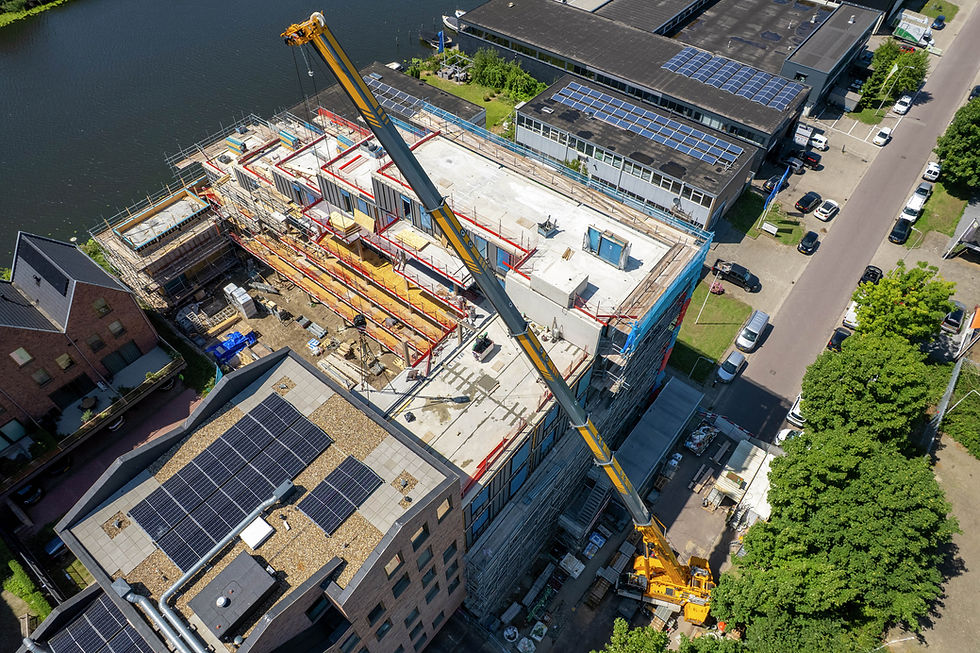
Dutch commerce and rental company Gebri received the first Liebherr LTR 1150 in the spring of this year. Since then, the telescopic crawler crane has been constantly in use for the crane hire company based near Utrecht. The new crawler crane recently completed an especially ambitious project just before the summer holidays. The crane was used to construct a modern, new-build property with 48 apartments in alphen aan den rijn. And it did so in a record-breaking time of just seven weeks. The building was recently completed on deadline.
For a challenging construction project in the Netherlands, the Liebherr LTR 1150 telescopic crawler crane was the ideal construction crane thanks to its performance data in terms of load capacity, boom radius and lifting height, as well as its ability to move with heavy loads on its hook. A large residential complex was being built in the harbour of Alphen aan den Rijn, situated between the cities of Amsterdam and Rotterdam. The building, which scales seven storeys in places, will house 48 apartments on a plot of just under 800 square metres. Due to its location between existing developed areas, a narrow road and the harbour basin, there was barely any free space and the crane set-up area, especially towards the end of the project, was severely restricted. Thanks to its fantastic flexibility and the mobility afforded by its crawler carriers, the LTR 1150 was initially able to complete the building, apart from one small section, from the later inner courtyard outwards. It then completed the complex from the road side.

“The spatial conditions meant that the use of an adequately powerful top-turning tower crane was not an option here,” explains Maichel van Vliet, who controlled the Liebherr crane throughout the construction project. “Even a mobile construction crane would have not delivered enough lifting power. When it came to lifting pre-fabricated elements with unit weights of up to 13 tonnes and a boom radius of around 18 metres, the LTR 1150 was simply the ideal tool. It’s small, agile and fast. These were major benefits for this construction project.” The boom, which telescoped to 45 metres and delivers maximum length of 52 metres, was able to deliver all of the storeys of the just under 25-metre-tall new building."

“100 lifts a day easily managed”
On site, moving the crawler crane while laden was crucial for another reason: the pre-fabricated components were delivered “just in time”. The LTR 1150 had to lift them from the heavy-duty transporters and then, ideally, travel directly to the installation site.
“The crane really helped us make fast progress with this. Each day, we’re able to complete an entire storey for each section of the construction,” explains Maichel van Vliet on the penultimate day on site, seated in the cab of his crawler crane. “In the morning, we position the walls, then everything goes up on the hook: from the bathrooms to the floors. And towards the evening, we place the ceiling panels on the wall elements. 100 lifts a day are no problem with this crane. Everything went smoothly. The fact that we’ll complete the building tomorrow on schedule and exactly on time is the best proof of this.”
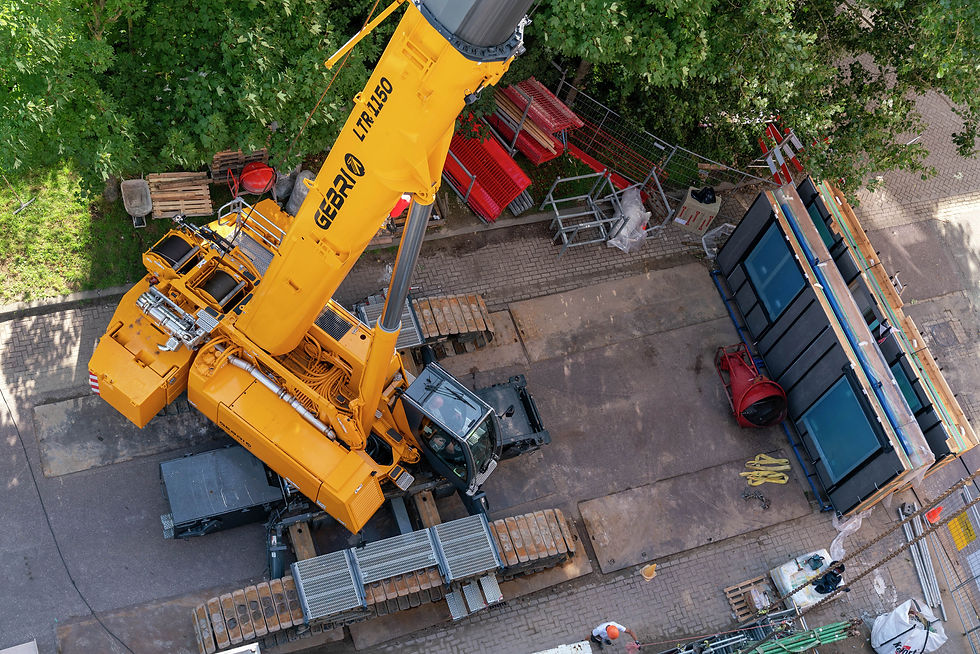
For Maichel van Vliet, who works for the construction firm Meijmat B.V., the job in Alphen was the first he’d completed with the LTR 1150. His conclusion: “A great crane that’s easy to operate. For its power with a lifting capacity of 150 tonnes, it cuts a very sleek figure. It’s also easy to transport. Tomorrow two trucks are coming to pick me and the crane up. Then we’ll be off to the next job that we’ll be completing together.”

The new telescopic crawler crane from crane hire firm Gebri will not just be used on residential construction projects.
“We’ll be hiring the LTR 1150 out for a lot of work involving precast concrete elements or for the assembly of large sand dredgers,” explains Gerhan van de Brink. He founded Gebri Handel & Verhuur B.V. with his father Henk in 2018.
At the company’s premises in Barneveld, east of Utrecht, a team of four looks after a sizeable fleet of 50 crane vehicles, which are generally hired out without drivers. Among them are 15 telescopic crawler cranes, with one Liebherr LTR 1220 being the most powerful machine in this segment. The modern fleet also includes specialist cranes, mobile construction cranes and a pool of over a dozen mobile cranes from Liebherr. The construction equipment is used not just in the Netherlands and Belgium, but also on international projects, including in Germany, Spain, Chile, Senegal, Hungary and the United Kingdom.


About Gebri Handel & Verhuur B.V.
Gebri Handel & Verhuur B.V. is a Netherlands-based crane rental and equipment hire specialist founded in 2018 by Gerhan and Henk van de Brink. Headquartered in Barneveld, near Utrecht, Gebri operates a modern fleet of approximately 50 crane units, the majority of which are hired out without operators to professional contractors across Europe and beyond.
The company has developed particular expertise in telescopic crawler cranes, operating one of the largest fleets in the region with 15 units ranging up to the Liebherr LTR 1220. Gebri’s portfolio also includes mobile cranes, mobile construction cranes, and specialist lifting equipment used in residential construction, precast concrete assembly, dredging, and inland waterway projects.
Gebri’s equipment is active not only in the Netherlands and Belgium, but also internationally, supporting projects in Germany, Spain, the United Kingdom, Hungary, Chile, Senegal, and beyond.
🔗 Website: https://www.gebri.nl
About Liebherr Telescopic Crawler Cranes
Liebherr telescopic crawler cranes combine the mobility of crawler travel gear with the speed and versatility of a telescopic boom, making them ideal for projects with limited space, changing lift locations, and just-in-time material delivery.
Models such as the LTR 1150 offer lifting capacities up to 150 tonnes, boom lengths exceeding 50 metres, and the ability to travel with heavy loads on the hook eliminating the need for repeated crane repositioning. This makes them particularly effective for residential construction, precast assembly, infrastructure projects, and industrial installations.
Manufactured by Liebherr-Werk Ehingen GmbH, Liebherr’s telescopic crawler cranes benefit from advanced control systems, high transport efficiency, and a global service network, ensuring high availability and long-term operational reliability.
🔗 Learn more: https://www.liebherr.com/mobile-and-crawler-cranes
Frequently Asked Questions
What makes the Liebherr LTR 1150 different from a mobile crane?
Unlike traditional mobile cranes, the LTR 1150 can travel with heavy loads suspended on the hook. This allows operators to lift prefabricated elements and move directly to the installation point without resetting the crane, saving time and space.
Why was the LTR 1150 ideal for this residential project?
The project site had extremely limited setup space between existing buildings, roads, and a harbor basin. The LTR 1150’s crawler mobility, compact footprint, and strong lifting performance at an 18-metre radius made it the only practical crane solution.
How fast was construction completed using the LTR 1150?
The 48-apartment residential complex was completed in just seven weeks, with the crane performing up to 100 lifts per day, an exceptional pace for a space-restricted urban build.
What types of loads did the crane handle?
The LTR 1150 lifted prefabricated wall elements, bathroom units, floors, and ceiling panels weighing up to 13–15 tonnes, placing them precisely at heights approaching 25 metres.
Where else will Gebri use the LTR 1150?
Beyond residential construction, Gebri plans to deploy the crane for precast concrete projects, dredging equipment assembly, and inland waterway applications where traveling with suspended loads is a major advantage.
Why are telescopic crawler cranes growing in popularity?
They offer a hybrid solution, combining high lifting capacity, fast setup, and on-site mobility making them increasingly attractive for urban construction, infrastructure upgrades, and projects where tower cranes or large mobiles are impractical.

