


Liebherr MK 88-4.1E Installs Noise Barriers on Live Rhine Valley Railway with Precision and Zero Disruption
Updated: Jan 12
30 Second Takeaway
Liebherr’s MK 88-4.1E mobile construction crane played a critical role in installing noise barriers along the busy Rhine Valley railway, demonstrating how electric operation, precision remote control, and advanced safety systems enable complex infrastructure work without disrupting live rail traffic. With programmable working area limitation preventing loads from passing over active tracks and the ability to operate from extremely confined positions, the MK 88-4.1E proved itself as a highly efficient and safe solution for rail corridor construction projects.

A Liebherr MK 88-4.1E mobile construction crane has installed massive noise barriers as part of the four-track expansion of the Rhine Valley railway between Karlsruhe and Basel. The crane installed elements weighing 900 kg at distances of up to 43 metres. The intelligent crane control system, including the freely programmable working area limitation, ensures a high level of safety and prevents the load from swiveling over the ongoing rail traffic.
Work on the infrastructure project to extend the four-track railway line from Karlsruhe to Basel has been underway at full speed in south-west Germany for years. In the region south of Freiburg im Breisgau, work on the tracks and overhead lines is almost complete. Large sections of the new and upgraded line are currently being fitted with noise barriers.
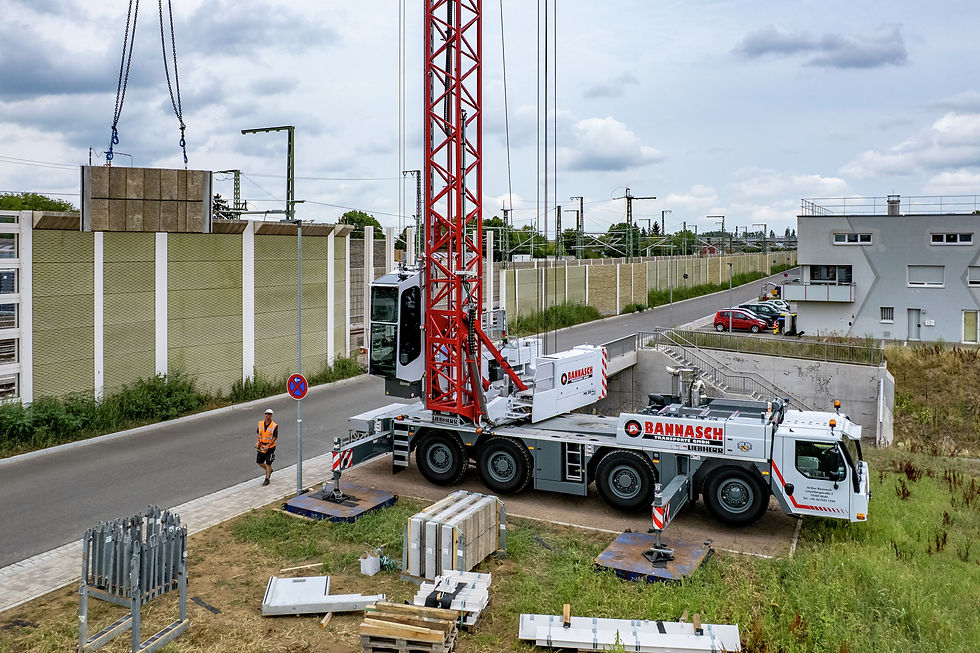
An MK 88-4.1E mobile construction crane from Arthur Bannasch Transporte GmbH in Wyhl am Kaiserstuhl has installed noise protection elements on the busy railway line in Müllheim, Baden. A mobile crane with a telescopic boom would not have been able to carry out this work due to the conditions on site. The only crane site that did not obstruct traffic was in the immediate vicinity of a six metre high street lighting mast. It was also not necessary to close the road to vehicle traffic, as the crane did not affect the road's clearance gauge due to its design.
Crane operator controls from the track bed
“I had to use my crane to install around 30 elements, each weighing 900 kilograms, for the new noise barrier. The largest radius was 43 metres,” explains Steffen Held, who has been operating the modern mobile construction crane for Bannasch for two years. However, the heaviest components were the steel wall frames, which were installed by the MK 88-4.1E with a gross load of around 2.8 tonnes at distances of up to 36 metres. Steffen Held controlled his crane from the ground during this job. He was always present on the newly constructed track bed when positioning the loads. “Firstly, I can guide the load very precisely from here when threading it into the racks and secondly, we were able to work very quickly because I could lend a hand when unhooking the load. I did the slinging all by myself anyway. Only one other worker from the construction company was needed for the entire operation. The two tracks being worked on were not yet open to rail traffic. However, there was a lot of train traffic behind the newly installed noise barrier. With my crane control system, I can programme the crane so that the trolley and slewing gear are limited in such a way that the load does not cross the tracks with active train traffic. That is of course a major safety aspect.”
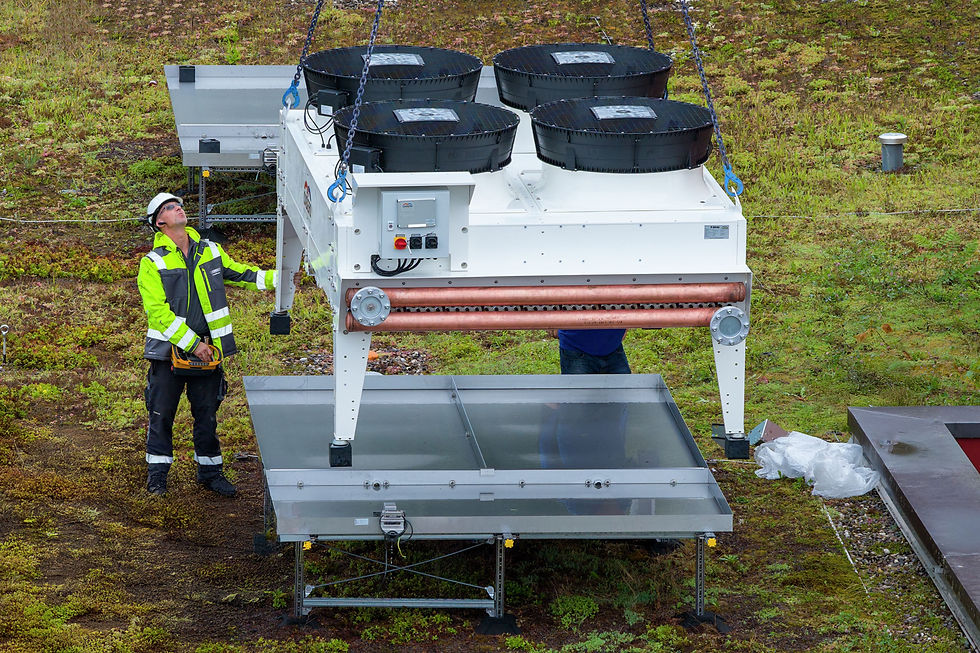
Steffen Held almost prefers to operate his crane by remote control during assembly work. When installing large air conditioning systems, he sometimes leaves the crane cab and navigates the heavy equipment directly at the installation site. Held appreciates this precision when guiding the load. He also appreciates being able to access site power for his crane during his work.
“Whenever I spot a site power distributor on the construction site, I ask if I can plug in there,” he explains. He always has a 15 metre three-phase cable for 32 A with him in his mobile construction crane. “Everyone on the construction site is always delighted and enjoys the silence.”

“We always have enough work for our two MK88-4.1s,” says Armin Bannasch, Managing Director and son of company founder Arthur Bannasch.“The cranes are mostly used for green roofs, the construction of prefabricated houses, steel erection and, increasingly, for the installation of air conditioning units.”
His driver adds: “And in winter, tree felling is increasingly on my programme. With the 45 metre boom, I can get very deep into the gardens from the road.” In addition to the two mobile construction cranes, the company operates a fleet of vehicles for transport tasks as well as two new smaller Liebherr mobile cranes and several lorries with loader cranes.
About Arthur Bannasch Transporte GmbH
Arthur Bannasch Transporte GmbH is a Germany-based specialist in crane services, lifting operations, and transport solutions, serving construction, infrastructure, industrial, and municipal projects across Baden-Württemberg and beyond. Founded as a family-run business and headquartered in Wyhl am Kaiserstuhl, the company has built a strong reputation for reliability, precision, and safe execution in technically demanding environments.
The company operates a modern fleet that includes Liebherr mobile construction cranes (MK series), mobile cranes, loader cranes, and specialized transport vehicles. This diverse equipment portfolio allows Bannasch to carry out a wide range of tasks, from railway and infrastructure works to urban lifting, prefabricated construction, steel erection, HVAC installation, and environmental projects.
Arthur Bannasch Transporte is particularly well known for its expertise in confined and sensitive job sites, where space restrictions, live traffic, or operational safety requirements demand advanced planning and precise crane control. The use of remote-controlled lifting operations, electric crane technology, and intelligent safety systems enables the company to execute projects efficiently while minimizing disruption to surrounding environments.
Now led by the second generation of the Bannasch family, the company continues to invest in modern Liebherr equipment and skilled personnel, ensuring it remains a trusted regional partner for complex lifting and transport solutions.
Learn More: https://www.bannasch-transporte.de/
About Liebherr Mobile Cranes, MK Series
Liebherr’s mobile construction cranes, including the MK 88-4.1E, combine the reach and precision of tower cranes with the mobility and rapid setup of mobile cranes. Designed for urban, infrastructure, and rail projects, MK cranes excel in environments where space, noise, and safety are critical constraints.
Manufactured by Liebherr-Werk Ehingen GmbH, these cranes feature advanced technologies such as LICCON crane control systems, programmable working area limitation, radio remote operation, and electric drive capability for emission-free lifting. Their vertical telescopic towers allow cranes to work over obstacles while occupying a minimal footprint on the ground.
Liebherr mobile construction cranes are widely used for railway works, noise barrier installation, steel erection, HVAC placement, prefabricated construction, and urban infrastructure projects, offering unmatched flexibility and safety in confined operating environments.
🔗 Learn more: https://www.liebherr.com/mobile-cranes
🔗 MK Series overview: https://www.liebherr.com/en/int/products/construction-machines/mobile-construction-cranes
Frequently Asked Questions
Why was the Liebherr MK 88-4.1E chosen for this railway project?
The MK 88-4.1E combines tower crane reach with mobile crane flexibility, allowing it to work at long radii of up to 43 metres while occupying minimal space. A conventional telescopic crane could not meet the site’s tight spatial and safety requirements.
How was safety ensured while trains continued operating nearby?
The crane’s freely programmable working area limitation ensured that loads could not swing over active railway tracks. This digital boundary control is a critical safety feature for projects involving live rail infrastructure.
What role did remote control play in the installation?
The operator controlled the crane directly from the track bed using radio remote control, enabling precise positioning of noise barrier elements while also allowing the operator to assist with slinging and unhooking, reducing manpower needs and speeding up installation.
How heavy were the noise barrier components?
Standard noise barrier elements weighed approximately 900 kg, while steel wall frames reached gross loads of up to 2.8 tonnes, all handled safely at long working radii.
Did the crane disrupt road or pedestrian traffic?
No. Thanks to the MK 88-4.1E’s compact design and vertical tower concept, the crane was positioned directly beside a street lighting mast without obstructing road clearance or requiring road closures.
What are the benefits of electric operation on such sites?
Electric operation allowed low-noise, emission-free lifting, improving conditions for nearby residents, rail operations, and construction crews. The crane could connect directly to site power, eliminating diesel engine noise.

