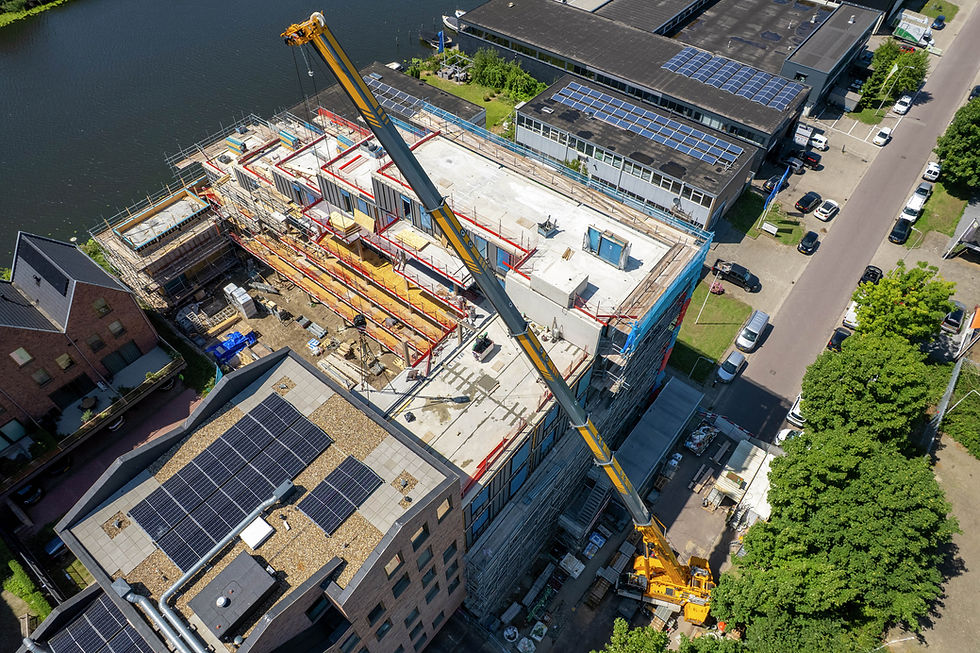
Liebherr mobile cranes construct research facility: “Only possible with the LTM 1650-8.1”
Updated: Jan 12
30 Second Takeaway
Riga Mainz successfully installed massive 87-tonne pipeline bridges at the FAIR particle accelerator research facility in Darmstadt using a Liebherr LTM 1650-8.1 mobile crane under extremely confined site conditions. With the crane positioned directly against a building wall, Liebherr’s VarioBallast® system proved decisive, allowing the ballast radius to be adjusted mid-lift and enabling precise placement where no other crane could operate. The project highlights how compact heavy-lift design, advanced crane control systems, and engineered transport solutions are essential for modern research and infrastructure construction.

For many years, the construction site of an international research facility in Darmstadt has witnessed mobile and crawler cranes being operated by Riga Mainz GmbH & Co. KG, a company specialising in crane and transport work. Now, mighty media bridges soaring some 20 metres into the air are being constructed around a building. Because of the limited crane parking space immediately adjacent to a building wall, the first module could only be lifted with the Liebherr LTM 1650-8.1 mobile crane. The crucial factor for this was the use of its VarioBallast® variable ballast device.

On the major construction site for the international FAIR research facility (Facility for Antiproton and Ion Research) to the north of Darmstadt, at the heart of which is a particle accelerator, the Liebherr cranes operated by Riga Mainz are a regular site.
On the international research project involving numerous countries, media bridges large pipeline bridges made from steel for the subsequent accommodation of all of the supply lines were assembled with gross loads of just under 87 tonnes on the outsides of the large facility building. The giant components first had to be transported from the assembly station, some 500 metres away, to the installation site. The team from Riga Mainz took care of this with an SPMT pairing from Scheurle. The ten axle lines carried the 32-metre-long, over eight-metre-wide and five-metre-tall modules safely across the narrow site road.

“LTM 1650-8.1 uses the tiniest corner of available space”

A fully equipped Liebherr LTM 1650-8.1 was on standby to lift the first giant component. Because of the local conditions, the 8-axle mobile crane was only able to be set up very close to an adjacent building. There was not enough parking space for the 800-tonne crane originally envisaged for the job by the client.
“The installation situation here is incredibly tight”, explained Andreas Webler, Project Planner at Riga Mainz, on the construction site. “The building wall means that this crane location is only possible with the LTM 1650-8.1 We only have a ballast radius of 6.40 metres for the pick-up and swinging of the load. To install the almost 87-tonne gross load at a distance of 23 metres, however, we had to increase it to 7.40 metres. That’s the unique thing about this crane: it can adapt to local conditions and use the tiniest corner of available space.”

“The highly compact support base we had just 9.60 metres from claw to claw – allows us to build up the crane with full support”, explains Webler. “For me, these dimensions of the support base are a very decisive advantage. The footprint required by this crane, with its load-bearing capacity of 700 tonnes, is almost identical to that of the LTM 1450-8.1. This means that it can handle not just small parking spots, but we also have the option of sending the LTM 1650-8.1 to a job for the 450-tonne model if it’s tied up at another location. This gives our scheduling team maximum flexibility.”

LICCON3 cranes impress
Equipped with a luffing jib and 175 tonnes of ballast on the turtntable, the lifting and assembly on 20-metre-tall reinforced concrete pillars went quickly and smoothly. One LTM 1110-5.2 had taken care of setting up the 24.5-metre-long luffing boom on the large crane in advance.
“This mobile crane is our first Liebherr machine with the new LICCON3 control system. And we’ve already ordered more”, reports project planner Webler. “We also recently received one of the first LTM 1100-5.3 cranes. With a width of just 2.55 metres and a basic ballast of 16.9 tonnes with a 12-tonne axle load for on-road driving, it really is fantastic as a setup crane for narrow spatial conditions. It will of course also be used for lots of crane work in halls. LICCON3, together with our in-house CAD planning, offers us many opportunities. We’re able to implement the plans on a one-to-one basis and always guarantee in advance that a crane job can be carried out as planned.”

The just under 50 machines in the traditional Mainz family-run company’s fleet of mobile and crawler cranes all come from Liebherr. Riga Mainz, however, offers its customers more than just crane work. Specialist and heavy goods transport, the handling and manoeuvring of bridge constructions and specialist projects such as major installation work in refineries are all part of the company’s regular portfolio. To be able to offer all this, the company also has 40 TII Scheuerle SPMT axle lines, a powerlift tower system with a load capacity of 500 tonnes per tower and numerous transport vehicles.

The FAIR research facility in Darmstadt marks a milestone in basic global research. As a joint project involving several countries, the facility aims to create new opportunities to learn more about the structure of materials and the development of the universe. The particles are accelerated in the accelerator system to almost the speed of light and subjected to scientific experiments.
About Riga Mainz GmbH & Co. KG
Riga Mainz GmbH & Co. KG is a Germany-based, family-owned specialist in crane operations, heavy transport, and engineered lifting solutions. With a fleet of nearly 50 Liebherr mobile and crawler cranes, the company supports complex projects across industrial construction, infrastructure, energy, and research facilities.
Beyond crane operations, Riga Mainz offers specialist transport services, bridge handling, SPMT operations, and large-scale industrial installations, including refinery and power plant work. Its logistics capabilities include 40 Scheuerle SPMT axle lines, a 500-tonne PowerLift tower system, and a wide range of transport vehicles, allowing the company to deliver integrated solutions from transport to final installation, even in highly constrained environments.
Learn More: https://www.riga-mainz.de/
About Liebherr Mobile & Crawler Cranes
Liebherr-Werk Ehingen GmbH is one of the world’s leading manufacturers of mobile and crawler cranes, offering lifting capacities from 35 tonnes to 3,000 tonnes. Based in Ehingen, Germany, the division employs approximately 5,000 people and serves global markets through an extensive international service network.
Liebherr’s crane portfolio is known for compact heavy-lift design, advanced control systems such as LICCON3, and innovative technologies including VarioBallast®, VarioBase®, and intelligent assistance systems. These solutions enable safe, precise lifting in demanding environments from dense urban construction sites to major infrastructure, energy, and research projects worldwide.
Learn More: https://www.liebherr.com/en-us/mobile-and-crawler-cranes/mobile-and-crawler-cranes-4407715
About TII Scheuerle
TII Scheuerle is a global leader in heavy-duty transport solutions, specializing in modular transporters, self-propelled modular transporters (SPMTs), and platform vehicles designed for the movement of oversized and extreme loads. Headquartered in Pfedelbach, Germany, Scheuerle operates as part of the TII Group (Transporter Industry International), one of the world’s foremost manufacturers of heavy transport systems.
Scheuerle equipment is widely used in infrastructure construction, energy projects, shipbuilding, industrial plants, and bridge installations, where precision, load stability, and maneuverability are critical. Its modular axle line technology enables transport of exceptionally large components, such as bridge sections, reactors, wind turbine components, and prefabricated industrial modules, through confined sites and challenging terrain.
As part of the TII Group, Scheuerle works closely alongside brands such as KAMAG and Nicolas, offering integrated transport solutions that combine engineering expertise, modular flexibility, and advanced control systems. The company’s transporters are trusted by crane and heavy lift specialists worldwide for complex logistics operations that require absolute reliability and precision.
Learn More🔗 https://www.tii-group.com
Frequently Asked Questions
Why was the Liebherr LTM 1650-8.1 selected for this lift?
The crane’s compact footprint, high lifting capacity, and VarioBallast® system made it the only crane capable of operating directly next to the building wall while safely lifting an 87-tonne load at a 23-metre radius.
What role did VarioBallast® play in the operation?
VarioBallast® allowed Riga Mainz to adjust the ballast radius from 6.40 m to 7.40 m during the lift, maximizing load capacity while staying within extremely limited space constraints, something not possible with conventional ballast systems.
How were the pipeline bridges transported to the installation point?
The 32-metre-long steel modules were transported approximately 500 meters using Scheuerle SPMTs, allowing safe movement across narrow site roads before being lifted into position.
What made the site conditions particularly challenging?
The crane had to be positioned directly beside an existing building wall, leaving only 9.60 m of support base width while installing heavy loads onto 20-metre-tall reinforced concrete pillars.
What technology improved lift precision and planning?
The project used Liebherr’s LICCON3 crane control system, integrated with Riga Mainz’s in-house CAD lift planning, allowing exact replication of lift scenarios and ensuring feasibility before execution.
What is the FAIR research facility?
FAIR (Facility for Antiproton and Ion Research) is an international particle accelerator project involving multiple countries, designed to advance global research into material structures and the origins of the universe.
What does this project demonstrate about modern crane operations?
It highlights how compact heavy-lift cranes, adaptive ballast systems, digital planning, and engineered transport solutions are critical to executing complex infrastructure projects in increasingly confined construction environments.