XCMG XGC400-1 and Liebherr LR 1350-1 LN Complete Sarens Bridge Lift in Indonesia
30-Second Takeaway
Sarens has installed two steel bridge girders, each weighing 280 tonnes, in Bekasi, Indonesia, using an XCMG XGC400-1 and a Liebherr LR 1350-1 LN in tandem. Working for DUA PERKASA PRIMA, the team lifted each girder approximately five metres before positioning it at installation radii of around 13 to 14 metres. Both crawler cranes used 36 metre main booms with superlift configurations selected for the loads and available working space. Mobilising the cranes required 39 heavy transport loads, with technical planning and coordinated crane movements central to the operation.
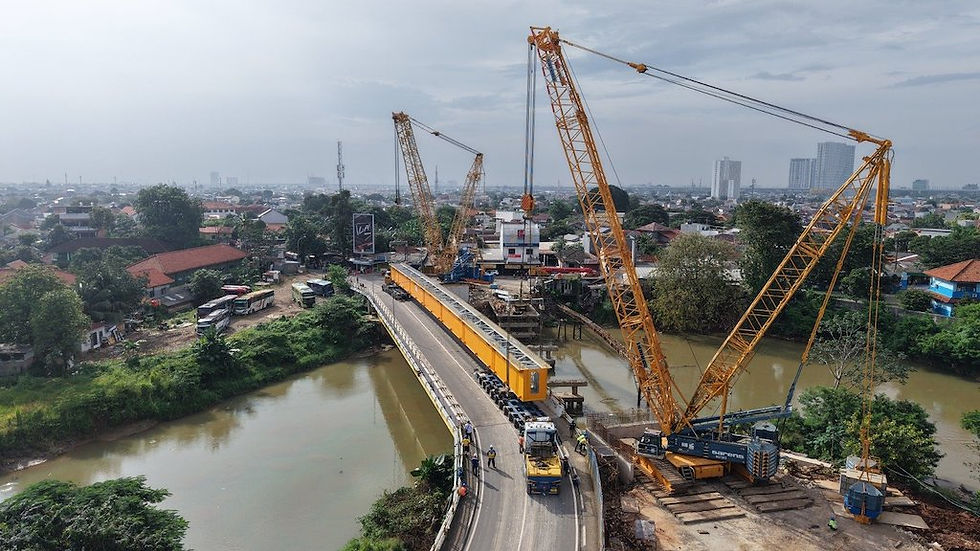
XCMG XGC400-1 and Liebherr LR 1350-1 LN
Sarens completed the lifting and installation of two 280 tonne steel bridge girders for an infrastructure project in Bekasi, Indonesia. The operation, carried out for DUA PERKASA PRIMA, used two crawler cranes working together to lift and position each girder.
Bekasi is a major industrial and logistics centre on Java. The bridge project supports improved access and connectivity as infrastructure development continues across the region.
Two Crawler Cranes Configured for Tandem Lifting
Sarens selected an XCMG XGC400-1 and a Liebherr LR 1350-1 LN for the installation.
The XCMG was configured with a 36 metre SHB main boom, a 12 metre superlift radius and counterweight listed as 110+40 tonnes. The Liebherr used a 36 metre LDB main boom, a 13 metre superlift radius and an 85+8 tonne counterweight arrangement.
These configurations provided the lifting capability required for the planned movements while accommodating the site’s working space and ground pressure requirements.
The two cranes shared each girder load during the tandem operation. Their movements had to remain coordinated as the load travelled from its pick-up position to the bridge installation point.
Positioning 280-Tonne Girders
Each girder was raised to an approximate height of five metres. Pick-up radii ranged between 16 and 18 metres, while final installation radii were approximately 13 to 14 metres.
The changing radii formed part of the lift planning, requiring the team to account for each crane’s working position and capacity throughout the movement. Accurate final positioning depended on controlled crane movements and communication between the operators and site team.
Sarens project manager Fadil Hasman Mojeres Syarif said:
“The key to the success of this project lay in meticulous technical planning and perfect on-site team coordination.”
He added that the selected crawler crane configurations provided the stability and capacity needed to position the girders accurately while managing ground pressure and limited working space.
Mobilisation Required 39 Transport Loads
Delivering the crane components to Bekasi required 39 heavy transport loads. The equipment was transported to site and assembled within the project schedule, bringing mobilisation and crane erection into the same coordinated programme as the lifting work.
For the operation, successful delivery depended on having both crawler cranes assembled and ready for the tandem lifts, with their boom and superlift arrangements prepared for the specified working radii.
Supporting Infrastructure in Western Java
The completed girder installation advances a bridge project intended to improve connectivity around Bekasi. The area’s industrial and logistics activity makes road access an important part of regional development. Additional infrastructure is expected to support freight movement and connections between industrial facilities and surrounding transport routes. Sarens’ scope covered the heavy lifting and installation work needed to place the two main steel girders.
About Sarens
Sarens is a Belgian family-owned group specialising in crane rental, heavy lifting and engineered transport. Sarens De Coster was established in 1955, with the family’s transport activities tracing back to forestry work in the early twentieth century.
The company expanded from regional operations into international lifting and transport projects, adding equipment such as barges and self-propelled modular transporters as its capabilities developed.
Today, Sarens operates through more than 100 entities worldwide. Its services combine engineering, specialist equipment and project execution for construction, energy, petrochemical, industrial and civil works customers.
Official website: www.sarens.com
About XCMG
XCMG is a construction machinery manufacturer based in Xuzhou, China. Its origins trace to the Huaxing Iron Factory, established in 1943, with crane manufacturing becoming part of its development during the following decades.
The company’s history includes tower crane production in the 1950s and truck crane development in the 1960s. Its wider business encompasses construction machinery, mining equipment, heavy trucks and machinery components.
XCMG supports international customers through a network of dealers, overseas subsidiaries, parts centres and service locations. Its equipment serves construction and industrial projects across global markets.
Official website: www.xcmgglobal.com
About Liebherr
Liebherr is a family-owned equipment and technology manufacturer founded by Hans Liebherr in 1949 in Kirchdorf an der Iller, Germany. Its lifting portfolio includes mobile and crawler cranes, tower cranes, mobile construction cranes and maritime cranes.
Liebherr-Werk Ehingen GmbH, established in 1969, develops and manufactures telescopic and lattice boom cranes on mobile and crawler chassis. These machines support infrastructure construction, industrial installation, energy projects and other heavy lifting applications.
The manufacturer provides technical support, spare parts, training and digital planning services alongside its equipment. Its crawler crane range offers different boom and ballast configurations to accommodate project-specific lifting requirements.
Official website: www.liebherr.com
Frequently Asked Questions
What did Sarens install in Bekasi?
Sarens installed two steel bridge girders, each weighing 280 tonnes.
Which cranes performed the lifts?
An XCMG XGC400-1 and a Liebherr LR 1350-1 LN crawler crane worked in tandem.
What boom lengths were used?
Both cranes were configured with 36 metre main booms.
What were the lifting radii?
Pick-up radii were between 16 and 18 metres, with final installation radii of approximately 13 to 14 metres.
How many transport loads were needed?
Mobilising the two cranes required 39 heavy transport loads.