


Liebherr LR 1800-1.0 Completes First Wind Turbine Installation for Nordex in Germany
Updated: Jan 14
30 Second Takeaway
Two 5.7 MW Nordex wind turbines were successfully erected in the Bitburg-Prüm district using the new Liebherr LR 1800-1.0 lattice boom crawler crane. The turbines, each with a hub height of 160 metres, were installed on a former military site by crane contractor Hofmann (part of the Bracht Group). The project marked the first deployment of the LR 1800-1.0, which was specifically developed for wind power installations and large-scale assembly work.

First LR 1800-1.0 crawler crane deployed for wind turbine erection
At the end of May 2024, two Nordex N163 5.7 MW wind turbines were erected on a former military radio station site in the Eifel region of Germany. The lifting operations were carried out by Hofmann, a crane company based in Paderborn and part of the Bracht Group.
The turbines feature a rotor diameter of 163 metres and are designed to supply electricity to several thousand households. According to Nordex site manager Frank Stanitzek, the complete erection of both turbines was completed within two weeks.
This project represented the first operational deployment of the Liebherr LR 1800-1.0, a high-capacity lattice boom crawler crane developed specifically for wind turbine construction and large-scale industrial assembly.
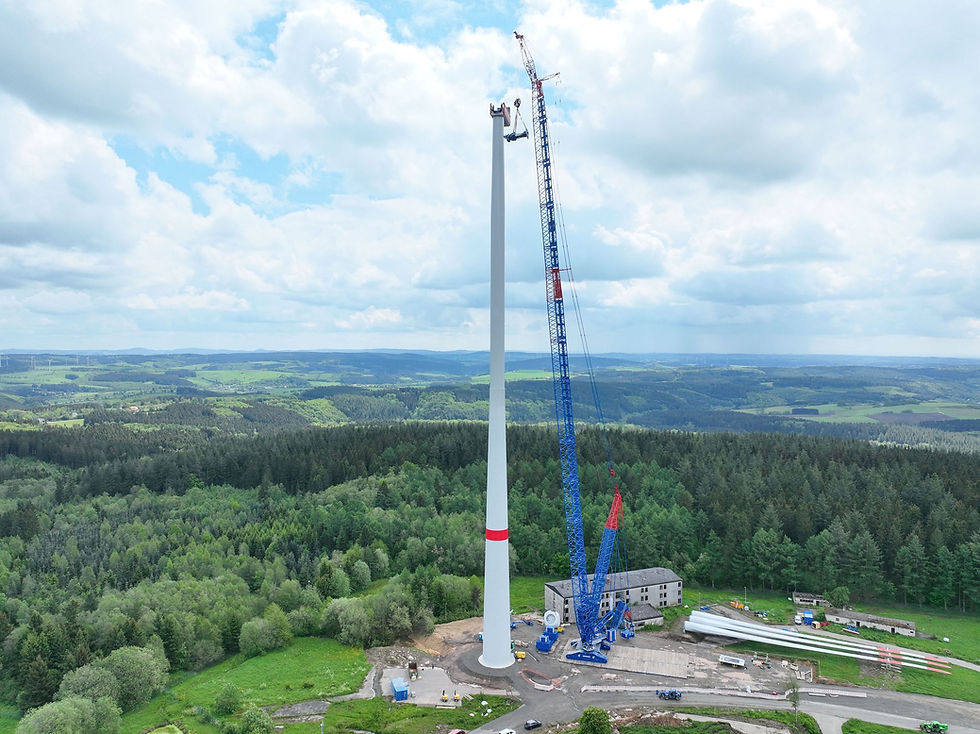
LR 1800-1.0 configured for high hub heights and heavy components
The Liebherr LR 1800-1.0 offers a maximum lifting capacity of 800 tonnes and can achieve hook heights exceeding 200 metres, making it suitable for modern wind turbines with large rotor diameters and high hub heights.
In April 2024, the crane was transported directly from the Liebherr plant in Ehingen to the Prüm site and assembled there for the first time in cooperation with Liebherr fitters.
The crane was configured in the HSL4 boom system, featuring:
A 165-metre main boom
A 12-metre lattice-type fixed jib
The HSL4 system is currently the most powerful boom configuration available for the LR 1800-1.0 in wind power applications. With a 174-metre main mast and a 21-metre fixed jib, the system enables the erection of wind turbines with hub heights of up to 179 metres.

Crane operation and lift performance on site
Crane operator Valerij Ren, who has worked with Hofmann since 2011 and has operated large Liebherr cranes for five years, highlighted the operational advantages of the new crawler crane.
“I was previously on the LR 1700-1.0 and can say that Liebherr crawler cranes are generally simple and easy to operate,” Ren said. “In particular, the monitors embedded in the armrests for monitoring the winches really make the work easier.”
The LR 1800-1.0, powered by a 455-kW Liebherr diesel engine, was ballasted with:
170 tonnes on the slewing platform
70 tonnes in the undercarriage
400 tonnes of suspended ballast
The full ballast configuration was required only for erecting the boom. During turbine installation, the crane operated with a reduced ballast load on the VarioTray® system.
At a working radius of approximately 28 metres, the crane lifted:
68-tonne nacelles
74-tonne drive trains
63-tonne hubs
Tower sections weighed 76 tonnes, 73 tonnes, and 51 tonnes, respectively.
Efficient dismantling and relocation between turbine sites
Following completion of the first turbine, the LR 1800-1.0 was fully dismantled and reassembled at the second turbine location approximately 300 metres away. According to Ren, the relocation was completed within one week using a team of six people and a 100-tonne auxiliary crane, underlining the crane’s ease of assembly.
The heaviest individual components during transport were the two 60-tonne crawler carriers. Thanks to Quick Connection, the slewing platform could be rapidly connected to the chassis centre section. In the configuration used on site, the complete crane system weighed approximately 900 tonnes and was transported using around 60 low-loaders.
To reduce transport volume, the 6- and 12-metre boom sections of the main boom, luffing jib, and fixed jib can be telescoped into each other up to three times.
Future deployments for LR 1800-1.0 in wind energy
Following its deployment in the Eifel region, Hofmann’s LR 1800-1.0 will move directly to northern Germany, where it will be used to erect the next generation of Nordex wind turbines with hub heights of up to 179 metres.
“The crane will not be returning to Paderborn for many years,”
said Dieter Abt, Head of Operations at Hofmann, highlighting the long-term demand for high-capacity crawler cranes in the wind energy sector

About Hofmann (Bracht Group)
Hofmann is a Germany-based crane contractor specialising in heavy lifting, crawler crane operations, and complex assembly work for wind energy, industrial, and infrastructure projects. As part of the Bracht Group, the company operates a fleet of high-capacity cranes supporting wind turbine erection, large component installation, and long-duration project deployments across Europe.
Website: https://www.bracht-autokran.de
About Liebherr
Liebherr develops and manufactures a comprehensive range of crawler cranes, mobile cranes, and lifting solutions for wind energy, industrial construction, and infrastructure projects worldwide. The LR crawler crane range, including the LR 1800-1.0, is designed to meet the requirements of modern wind turbine installation, offering high lifting capacities, extended hook heights, and transport-efficient boom systems.
Website: https://www.liebherr.com
Frequently Asked Questions
What wind turbines were installed using the Liebherr LR 1800-1.0?
Two Nordex N163 5.7 MW
wind turbines with a hub height of 160 metres were installed.
What makes the LR 1800-1.0 suitable for modern wind turbines?
Its 800-tonne lifting capacity, hook heights over 200 metres, and high-performance boom systems support large turbine components and high hub heights.
What is the HSL4 boom system?
The HSL4 system is the most powerful boom configuration for the LR 1800-1.0, enabling turbine installation at hub heights of up to 179 metres.
How quickly can the LR 1800-1.0 be dismantled and relocated?
The crane can be dismantled and reassembled within one week using a small crew and an auxiliary crane.
Where will the crane be deployed next?
Following the Eifel project, the crane will be used to install next-generation Nordex turbines in northern Germany.


