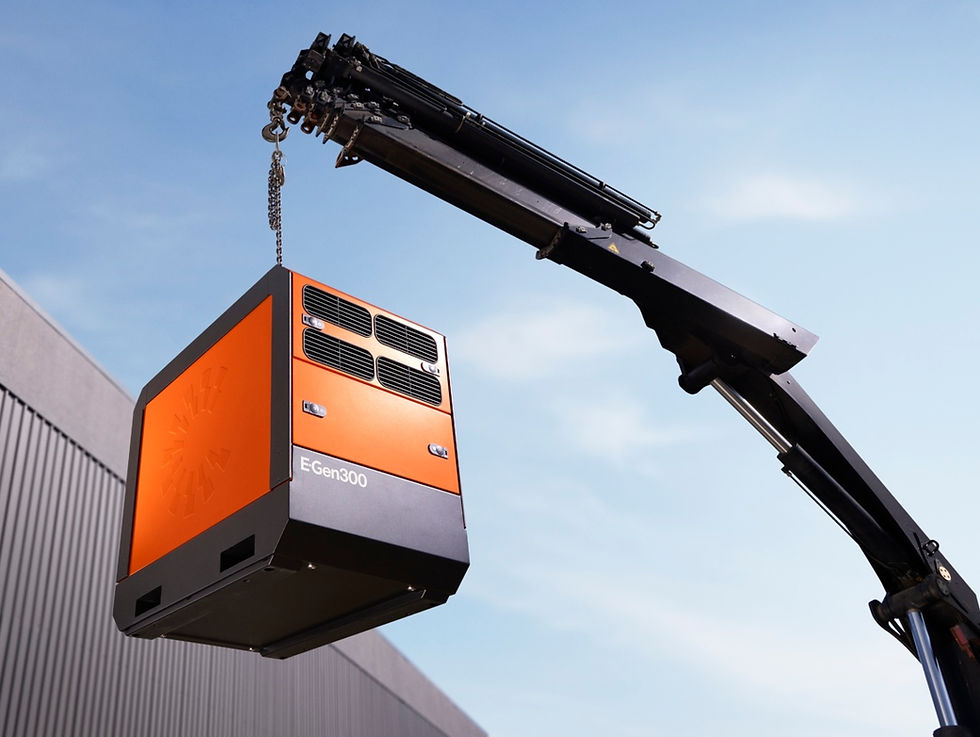
JMG Advances Sustainable Industrial Lifting With Hydrogen-Powered MC250.09FL
- Meagan Wood

- Jun 18, 2025
- 3 min read
30-Second Takeaway
JMG is accelerating the shift toward low-emission industrial lifting with the debut of its hydrogen-powered MC250.09FL prototype at Hydrogen Expo 2025. Designed to reduce carbon impact without sacrificing productivity, the fuel cell–electric crane combines fast refueling, extended operating range, and system flexibility, offering a practical pathway toward sustainable, zero-emission lifting ahead of its planned 2026 commercialization.

Sustainability as a Design Principle, Not an Add-On
As heavy industry searches for credible pathways to decarbonization, JMG is positioning sustainability at the core of its equipment design not as a retrofit, but as a foundational principle.
The MC250.09FL was originally conceived as an electric, self-propelled industrial crane capable of lifting heavy loads close to its center of gravity while maintaining stability and precision. That same modular, electric-first architecture has now enabled JMG to integrate hydrogen fuel cell technology without redesigning the machine from the ground up.
This approach supports a key sustainability objective: reducing emissions while preserving operational continuity for industrial users.
Hydrogen Fuel Cells: A Practical Step Toward Decarbonization
At the heart of the system is the FCH 96V PEFC fuel cell module, paired with a 30 kWh lithium buffer battery. Rather than relying solely on battery capacity or long recharge cycles, the fuel cell generates electricity on demand to maintain battery charge, reducing energy waste and improving efficiency during intensive duty cycles. This hybrid configuration supports a combined operating range of approximately 5–6 hours, while maintaining zero local emissions at the point of use.
Energy Flexibility Supports Sustainable Operations
One of the most significant sustainability advantages of the MC250.09FL lies in its energy flexibility.
The hydrogen module mirrors the size, weight, and interfaces of the standard lead-acid battery system, making it fully interchangeable with minimal wiring adjustments. This design allows operators to transition toward hydrogen without abandoning existing infrastructure lowering barriers to adoption and extending equipment lifecycle value.
When hydrogen is available, refueling takes just five minutes, significantly reducing idle time and avoiding the energy losses associated with prolonged charging. In environments where hydrogen infrastructure is not yet in place, the crane can still operate using its lithium battery alone, recharging in approximately 90 minutes for shorter work cycles.
Reducing Downtime, Extending Lifecycle Value
Sustainability in industrial equipment is not only about emissions it also encompasses resource efficiency, machine longevity, and productivity.
The MC250.09FL’s advanced four-wheel steering and optimized load distribution reduce structural stress, helping extend service life and lower long-term material consumption. Fast refueling and reduced downtime further support efficient use of assets, allowing fewer machines to accomplish more work over time.
By enabling longer operating cycles without emissions or productivity penalties, JMG is addressing one of the key challenges in sustainable heavy equipment adoption.
A Strategic Milestone in Industrial Energy Transition
For JMG, the hydrogen-powered MC250.09FL represents more than a prototype it signals a long-term commitment to alternative energy systems that can scale across industrial lifting applications.
Guided by founder and CEO Maurizio Manzini, the project reflects a belief that sustainability must be practical, modular, and aligned with real operating conditions. Commercialization of the hydrogen variant is planned for 2026, positioning JMG at the forefront of zero-emission lifting solutions as regulatory and customer expectations continue to evolve.
About JMG
JMG is an Italian manufacturer specializing in electric pick-and-carry cranes and compact industrial lifting solutions designed for precision handling in confined and sensitive environments. Founded in Italy, JMG is recognized for its focus on electric power, innovative engineering, and machines that support low-emission, indoor, and industrial applications.
JMG’s crane portfolio is widely used in manufacturing plants, infrastructure projects, logistics facilities, and specialized lifting operations where maneuverability, safety, and environmental performance are critical. The company places strong emphasis on research and development, continuously advancing electric drive systems, control technologies, and alternative energy concepts to meet evolving industry requirements.
Operating through a global dealer and partner network, JMG serves customers worldwide and is regarded as a pioneer in electric industrial lifting solutions.
Frequently Asked Questions
How does hydrogen power improve sustainability for industrial lifting?
Hydrogen fuel cells produce electricity with zero local emissions and, when paired with renewable hydrogen, can significantly reduce lifecycle carbon impact compared to diesel or conventional charging methods.
What is the operating range of the MC250.09FL hydrogen prototype?
The combined fuel cell and lithium battery system delivers approximately 5–6 hours of operation.
Does hydrogen refueling reduce downtime?
Yes. Refueling takes around five minutes, compared to several hours for traditional battery charging.
Is the hydrogen system compatible with existing machines?
The hydrogen module is designed to be interchangeable with the standard battery system, enabling flexible adoption without major machine redesign.
When will the hydrogen MC250.09FL be available commercially?
JMG plans to launch the hydrogen-powered version in 2026.