Mammoet Executes 6,200-Tonne Load-Out for Landmark Wind-Powered Offshore Platform
Updated: Jan 19
30-Second Takeaway
Mammoet delivered a landmark heavy-lift operation for the N05-A offshore gas platform in the Dutch North Sea, handling the simultaneous load-out of a 3,050-tonne topside and 3,150-tonne jacket. Using a fleet of Liebherr mobile cranes, SPMTs, advanced mooring solutions, and early-stage engineering, Mammoet compressed schedules, overcame unprecedented load-out constraints, and supported one of Europe’s lowest-carbon offshore gas developments.

The N05-A platform marks a milestone as the first offshore gas platform in the Dutch North Sea to operate entirely on wind power, utilizing electricity sourced via cable from the adjacent 113.4 MW Riffgat offshore wind farm.

This platform is an integral component of the GEMS (‘Gateway to the Ems’) project, which is dedicated to the development of field N05-A and surrounding fields located in the waters along the Netherlands-Germany border. The electrification of the N05-A platform is projected to lead to a remarkable reduction in carbon emissions, exceeding 85% throughout the project's lifecycle.

Mammoet was engaged by HSM Offshore to facilitate the load-out of the 3,050-ton N05-A topside and the 3,150-ton jacket at HSM’s fabrication facility located in Schiedam, Rotterdam.
Mammoet’s responsibility for the project entailed the successful load-out of both components onto a barge for maritime transport. The offshore sailing and installation processes were managed by ONE-Dyas, the platform's owner.

Through a strategic engineering approach, Mammoet enabled the jacket to be assembled more efficiently in proximity to its installation site, thereby reducing construction lead time.
The assembly and weighing of the jacket and topside were executed using mobile cranes, conventional trailers, and Self-Propelled Modular Transporters (SPMTs).

The initial operational phase of the project involved assisting with the movement and assembly of the jacket, which was fabricated and constructed in two segments.
Mammoet facilitated the heavy transport and upending of the jacket’s sections employing four mobile cranes: two LTM 1650 (650-ton) cranes and two LTM 1450 (450-ton) cranes. The installation of the pile sleeves was accomplished with the aid of a 750-ton mobile crane.
Upon reaching the correct positioning, the top section of the jacket was relocated to the quayside, where heavy lifting operations were conducted using two sheerlegs. This maneuver created the necessary space for the bottom section to be positioned underneath for a seamless connection.
Self-Propelled Modular Transporters (SPMTs) were utilized to maneuver the topside outside the fabrication facility and onto the quay. Mammoet subsequently assisted in the installation of a pedestal crane onto the topside using conventional trailers and mobile cranes.
With the jacket and topside fully assembled, both components were lifted by SPMTs, and their final weights were accurately determined using Mammoet load cells. The load-out operation commenced following the weighing of both structures.
Shipping both parts of the offshore gas platform concurrently was essential to adhere to the project schedule.
One of the primary challenges faced during this project was the load-out phase. Typically, a barge would accommodate either a topside or a jacket for loadouts of this nature; however, in this instance, both structures had to be loaded onto the same vessel to expedite the overall timeline.
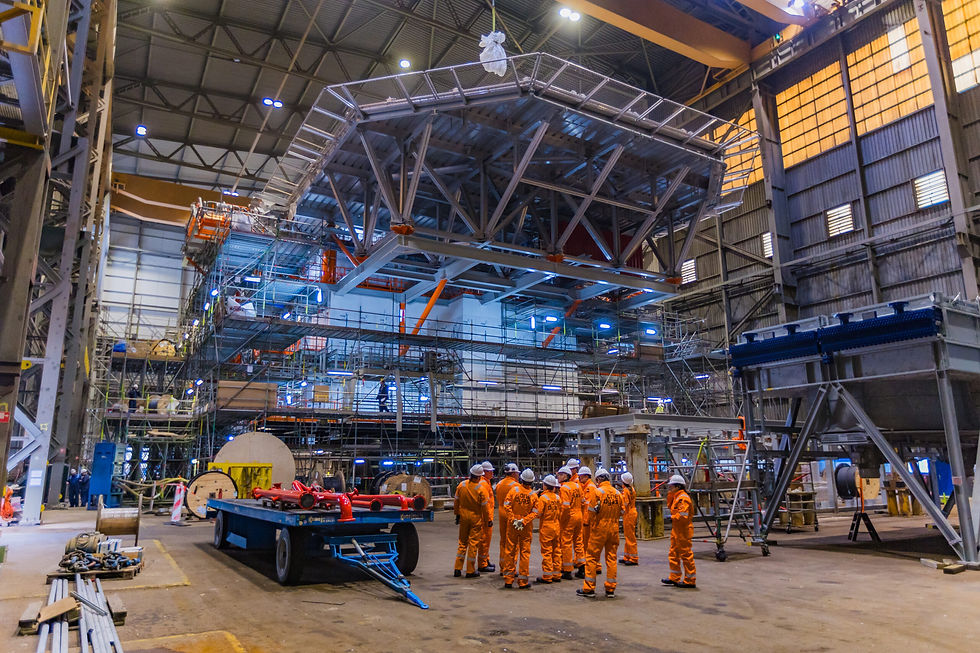
This requirement posed spatial and engineering challenges, necessitating accommodations for the installation of pumps and winches on the transport vessel. The combined loads also prohibited the application of conventional mooring techniques.
“The mooring was particularly critical, necessitating extensive engineering,” explains Sven Segeren, Project Manager at Mammoet. “Ordinarily, we would implement a winch configuration to moor and stabilize the vessel, yet this was not feasible due to the substantial forces exerted by the heavy loads. The winch loads exceeded safe limits, and the bollards lacked sufficient strength; thus, we employed a small spud leg barge to secure the vessel and maintain its position throughout the load-out process.”

Preparation of the main barge took five days, during which ballast equipment was installed, pre-ballasting was performed, and sailing conditions were assessed for the final location.
The load-out operation for both the jacket foundation and topside was successfully completed in just two days, utilizing four trains of 32 axle line SPMT trailers for transport.
Due to external factors beyond the project's control, the execution date remained uncertain for an extended period. Consequently, Mammoet was tasked with preparing a temporary load-in venue to ensure the continuity of subsequent projects at the HSM Offshore yard.
The team organized Mammoet’s own yard in Schiedam, adjacent to HSM Offshore, to facilitate the load-in of the topside and jacket. This involved preparing an area for temporary storage of the components, reserving necessary equipment, and creating essential engineering plans. Ultimately, this designated space was not required; however, Mammoet demonstrated agility and adaptability in response to a dynamic operational environment.
“We maintain a strong collaborative relationship with HSM Offshore, engaging with them at the outset of projects to provide innovative assembly solutions,” adds Segeren.
“Through effective collaboration and our early involvement, we successfully devised a strategic approach for the assembly of the jacket, thereby minimizing construction lead time.”
About Mammoet
Mammoet is a global specialist in engineered heavy lifting, transport, and installation services, supporting the world’s most complex energy, infrastructure, and industrial projects. The company’s core strength lies not only in its fleet—one of the largest and most diverse in the world, but in its early-stage engineering involvement, where lift strategy, transport logic, contingency planning, and constructability are defined long before execution begins.
For offshore energy projects, Mammoet routinely manages topsides, jackets, modules, and foundations exceeding several thousand tonnes, integrating mobile cranes, crawler cranes, SPMTs, skidding systems, load cells, and bespoke mooring solutions. Its engineering teams develop project-specific methodologies using advanced simulation, load modeling, and interface management to safely operate within tight spatial, environmental, and schedule constraints.
In the N05-A project, Mammoet’s ability to combine heavy mobile crane lifting, SPMT transport, precision weighing, and non-standard barge mooring solutions was critical to compressing the schedule while maintaining full control of risk. This project exemplifies Mammoet’s role as a solution integrator, not just a lifting contractor.
Website https://www.mammoet.com
About Liebherr Mobile Cranes
Liebherr Mobile Cranes are engineered to deliver superior performance, flexibility, and safety across a wide range of lifting applications worldwide. Manufactured primarily by Liebherr-Werk Ehingen GmbH in Germany, the mobile crane portfolio spans from compact 35-tonne, 2-axle models to heavy-duty 9-axle cranes with capacities over 1,200 tonnes, designed to tackle infrastructure, industrial, marine, and energy projects.
Liebherr mobile cranes are distinguished by their innovative design, modular configurations, and advanced control systems:
VarioBase® independently adjustable outriggers that maximize stability and lifting capacity in confined spaces.
VarioBallast® variable ballast positioning that enhances lift performance while reducing transport and setup footprint.
LICCON (LIebherr Computed Control) a proven crane control system delivering real-time functionality, safety limits, and operator assistance.
Liebherr Connect integrated connectivity enabling real-time fleet telemetry, maintenance data, and digital diagnostics.
The fleet encompasses a broad range of models, including:
All-Terrain Cranes (LTM) highly mobile, road-legal cranes optimized for fast setup and long-reach performance.
Telescopic Crawler Cranes offering mobility with heavy lifting capacity where ground conditions or access are challenging.
Rough Terrain and Industrial Variants tailored for off-road or confined site operations.
Liebherr mobile cranes are supported by a global service and parts network, ensuring high availability of equipment, prompt technical support, and lifecycle support for operators and rental partners. From major infrastructure projects and heavy industrial lifts to complex offshore and energy installations, Liebherr mobile cranes provide trusted solutions across demanding environments.
About the N05-A Platform & GEMS Project
The N05-A platform is a milestone offshore development as the first gas production platform in the Dutch North Sea powered entirely by renewable electricity. Instead of conventional gas turbines offshore, the platform receives power via subsea cable from the 113.4 MW Riffgat offshore wind farm, significantly reducing operational emissions.
The platform is part of the GEMS (Gateway to the Ems) project, led by ONE-Dyas, targeting gas fields along the Netherlands–Germany maritime border. By electrifying production infrastructure and optimizing offshore logistics, the project is expected to achieve more than 85% CO₂ reduction over its lifecycle, setting a new benchmark for lower-carbon offshore gas developments in Europe.
The engineering and logistics strategy behind N05-A demonstrates how heavy lifting, transport sequencing, and sustainability objectives are now directly interconnected in modern offshore projects.
Frequently Asked Questions
Why is this lift considered exceptional in offshore construction?
The simultaneous load-out of both a 3,050-tonne topside and a 3,150-tonne jacket onto a single barge is highly uncommon. Most offshore projects ship these components separately due to space, stability, and mooring limitations. Executing both together required non-standard engineering solutions and flawless coordination.
Why couldn’t conventional mooring systems be used?
The combined mass and footprint of the jacket and topside generated winch forces beyond safe operating limits, while available bollards lacked sufficient structural capacity. Traditional mooring layouts would have introduced unacceptable risk. Mammoet engineered a solution using a spud-leg barge to stabilize the transport vessel during load-out.
What role did mobile cranes play in the project?
Mobile cranes were critical during jacket assembly and upending, where Mammoet deployed:
Two LTM 1650 (650-ton) cranes
Two LTM 1450 (450-ton) cranes
One 750-ton mobile crane for pile sleeve installation
This configuration allowed precise handling of large components within the fabrication yard before transfer to SPMTs.
Why were SPMTs essential rather than fixed lifting methods?
SPMTs enabled controlled transport of both structures from fabrication halls to the quay, allowed for accurate weighing using load cells, and provided flexibility in positioning. Their modular axle lines distributed extreme loads while maintaining maneuverability in confined yard conditions.
How did early engineering shorten the project timeline?
By engaging early, Mammoet enabled the jacket to be assembled closer to its installation location, reducing rehandling, crane relocations, and offshore installation time. This approach compressed the overall schedule and reduced exposure to weather-related delays.
What was the biggest execution risk during the project?
Schedule uncertainty posed a major risk. To mitigate this, Mammoet engineered a fully prepared contingency load-in area at its own Schiedam yard, ensuring HSM Offshore’s ongoing production could continue even if execution dates shifted.
How does this project support sustainability beyond electrification?
Beyond enabling a wind-powered platform, Mammoet reduced emissions by:
Combining shipments into a single sail
Reducing offshore installation duration
Minimizing equipment mobilizations
Eliminating redundant lifting steps
Engineering efficiency directly contributed to environmental performance.
Why does Crane Hub recognize this as Lift of the Month?
This project exemplifies what defines elite heavy lifting today:engineering foresight, execution under constraint, schedule compression, and measurable sustainability impact, not simply crane size.