


Fatal Bridge Strike Involving Truck-Mounted Lift Near Lithgow, Australia
30-Second Takeaway
A 34-year-old man was killed near Lithgow, New South Wales, after the truck-mounted lift he was travelling in struck a low railway bridge, causing the bridge structure to collapse onto the vehicle’s cab. The incident occurred earlier today north-west of Sydney. The driver escaped and was hospitalised in stable condition, while the passenger was trapped and later declared dead at the scene. Authorities are investigating the circumstances of the bridge strike.
Incident Overview
A fatal vehicle and access-equipment incident occurred earlier today near the town of Lithgow, north-west of Sydney, in New South Wales, Australia.
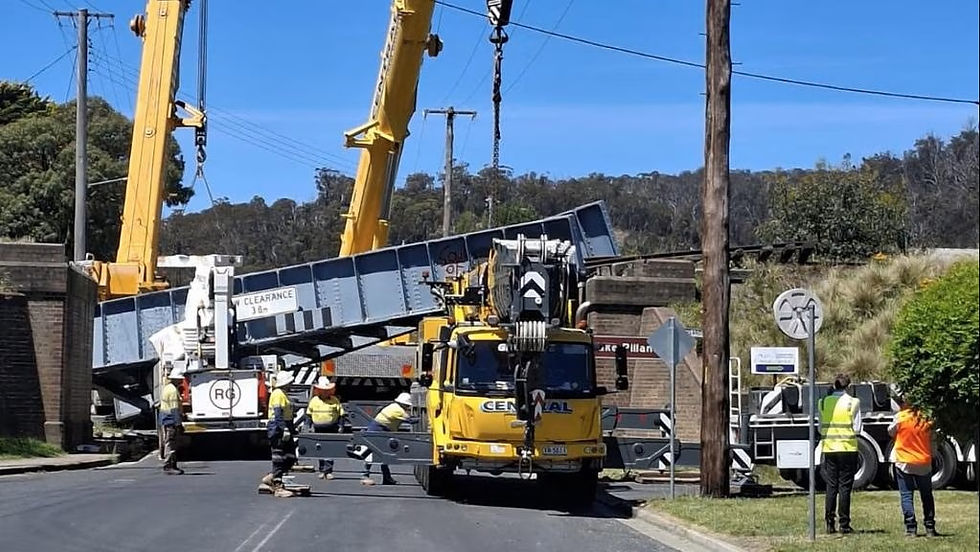
A truck-mounted insulated access platform struck the underside of a low railway bridge, causing the bridge to collapse onto the vehicle and crush the cab.
What Is Known
Location: Near Lithgow, NSW, Australia
Bridge: Railway bridge carrying an old section of the Zig Zag railway line
Bridge clearance: 3.8 metres
Vehicle: Three-axle Redmond Gary insulated truck-mounted lift
Fatality:
Male, 34, passenger
Injured:
Male, 38, driver (stable condition)
Employer: Sydney Trains (both men)
The passenger was trapped in the cab and it took several hours for emergency crews to free him. He was declared dead at the scene.

Equipment and Clearance Context
The truck-mounted lift involved is described as one of the larger Redmond Gary models. Based on the model believed to be involved:
Typical overall travel height is around 4.1 metres
Actual height can vary depending on chassis configuration
Other bridges further along the same route reportedly have clearances exceeding four metres, whereas the bridge involved in this incident was clearly marked at 3.8 metres.
Emergency Response and Recovery
Emergency services responded quickly to the scene.
The driver was able to self-extricate and was transported to hospital
The passenger remained trapped and rescue operations continued for several hours
To remove the collapsed bridge structure, three all-terrain cranes were mobilised:
One five-axle crane from Henry Plant & Equipment
One four-axle and one five-axle crane from Central
The bridge was lifted onto trucks and removed, allowing investigators access to the truck-mounted lift.

Investigation Status
Authorities are investigating:
Vehicle route selection
Height awareness and clearance planning
Bridge signage and visibility
Operational procedures for high-reach vehicles
No official findings have yet been released.
Crane Hub Global will update this article as verified information becomes available.
Why Incidents Like This Can Occur
Bridge-strike incidents involving truck-mounted platforms can occur when:
Vehicle height exceeds bridge clearance
Route planning does not account for low structures
Drivers rely on assumed or inconsistent clearance along a route
Variations in vehicle configuration change overall height
Once contact occurs at speed, bridge and vehicle damage can escalate rapidly.
Industry Reminder
Bridge strikes remain a leading cause of fatal incidents involving truck-mounted access platforms. Clearance inconsistencies along a route can create a false sense of security.
This tragic incident underscores the importance of height awareness, disciplined route planning, and conservative decision-making when operating over-height vehicles.
Editorial Note
Crane Hub Global reports on crane and access-equipment incidents to support industry awareness and prevention. This article reflects confirmed information available at the time of publication and will be updated as official findings are released.
How Incidents Like This Can Be Prevented
Accurate Vehicle Height Awareness
Operators must know the exact travel height of their vehicle for its current configuration.
Route Planning for Over-Height Vehicles
Routes should be pre-planned and approved, accounting for all low bridges and overhead obstructions.
Use of Height-Restriction Alerts
Navigation systems and route permits should flag low-clearance structures before travel.
Clear Bridge Signage Compliance
Height restriction signage must be observed without exception, regardless of conditions elsewhere on the route.
Stop-Before-Strike Protocols
Drivers should stop immediately if clearance is uncertain rather than attempting to proceed.


